U.S. employers posted nearly 600,000 skilled-trades openings last year. Roughly 150,000 new workers entered the trades through apprenticeship programs. That gap, according to a recent report from commercial real estate firm JLL, could leave 2.1 million positions unfilled by 2030 and cost the economy as much as $1 trillion a year.
Mike Feinberg has been chipping away at his version of a fix since 2020. “We are employer-focused,” says Feinberg, co-founder of WorkTexas, the Houston nonprofit that trains adults and high schoolers for trades careers. “Our mission is to help people get jobs, keep jobs, and advance in careers.” That mission statement leaves something out on purpose: it never mentions training or certificates. More on his background is on his TXSVF biography.
Why Mike Feinberg Built WorkTexas Around Employers, Not Credentials
Feinberg’s critique of the workforce-training industry is less a policy argument than a measurement problem. “You go to community colleges, trade schools, and ask them, ‘Are you successful? How do you know you’re doing a good job?’” he says. “And they say, ‘97.8% of our students earn a certificate.’ How many of those people got jobs? They don’t know.”
WorkTexas was built to know. More than 100 employer partners across Houston helped shape the curriculum. “We start with the employer,” says Yazmin Guerra, the organization’s vice president and director of workforce development. “We always ask, ‘If we could wave a magic wand, how many people could you hire tomorrow?’” Adults employed a year or more after finishing earn an average of $23 an hour, with an 88% completion rate in the 2023-24 year.
Mike Feinberg’s Model Is Already Replicating Itself
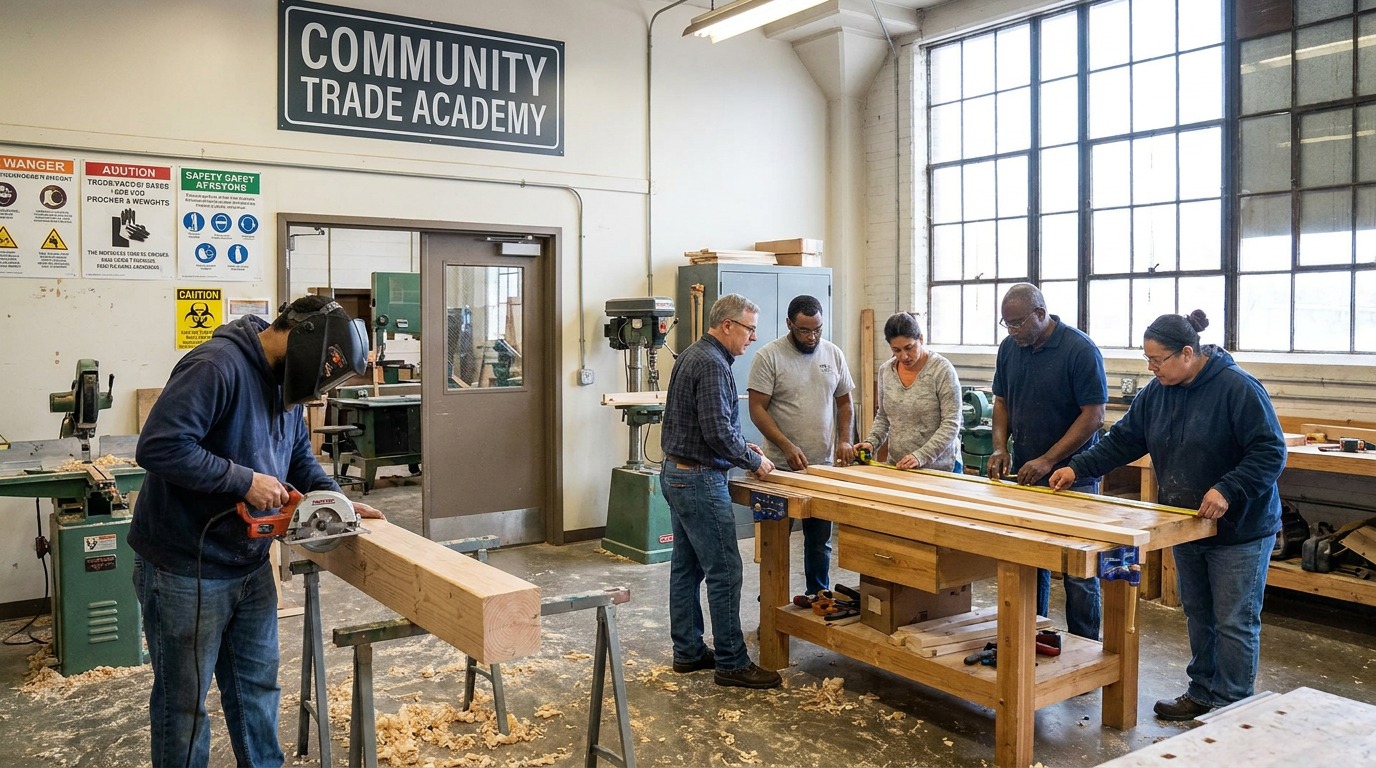
WorkTexas runs at two Houston campuses, one inside a Gallery Furniture showroom donated by Jim “Mattress Mack” McIngvale, the other at a former juvenile detention facility now called the Opportunity Center. Together they served 300 adults, 90 justice-involved youth and 70 high school students in the 2025-26 year, numbers Feinberg admits are modest next to a 2.1 million job gap.
His argument is that the model travels, not that WorkTexas alone closes the gap. When a Houston housing company wanted to train apartment maintenance technicians in Austin, local partners pulled together a first cohort in April 2025 using the same playbook. Richard Whatcott, the Camden regional vice president who organized it, credited his Texas Apartment Association contact as the connector who made it happen. “She became the Mike Feinberg in Austin,” he said.
Feinberg has made a similar point himself: “Every community has someone like a Mack who is a connector or a local celebrity who could play that role.” Feinberg, who keeps a public speaker profile and posts updates on Facebook, thinks the case for the trades is largely won. What’s left, he says, is building training infrastructure fast enough to matter.